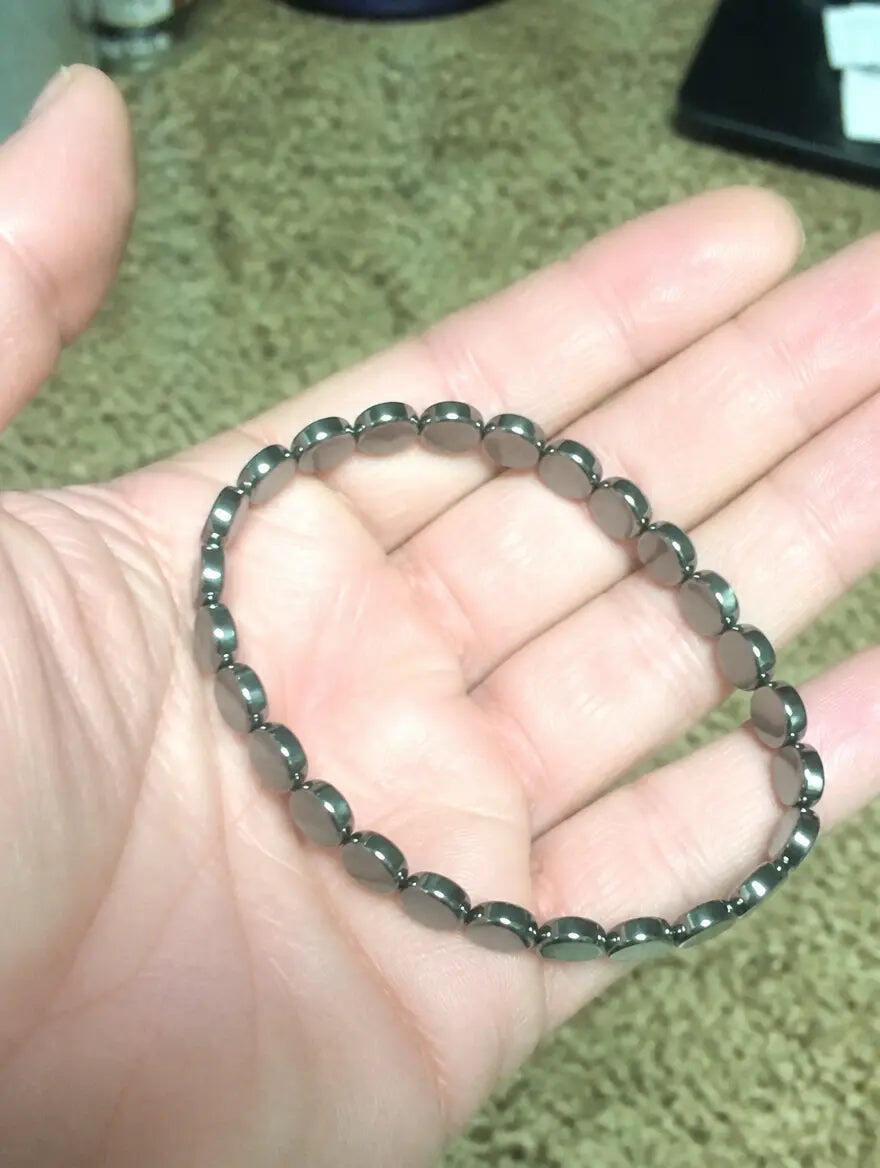
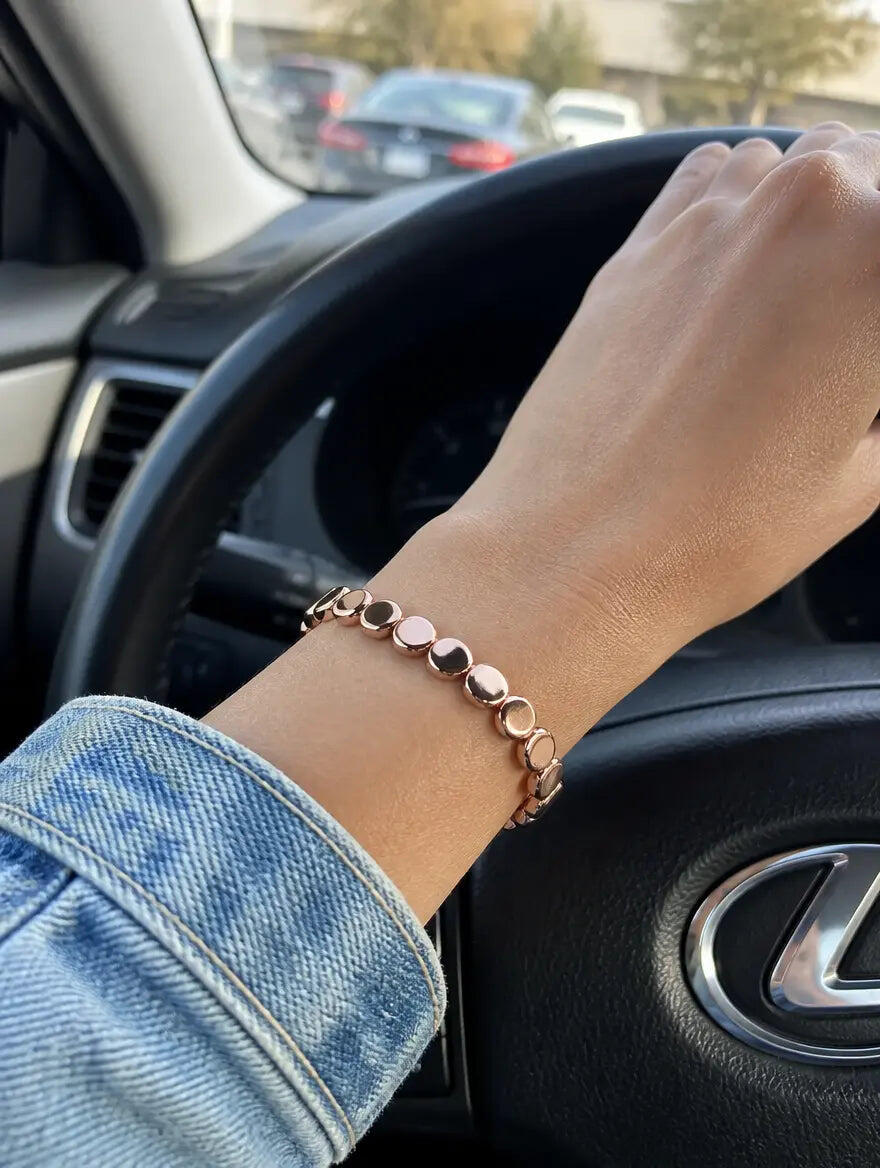
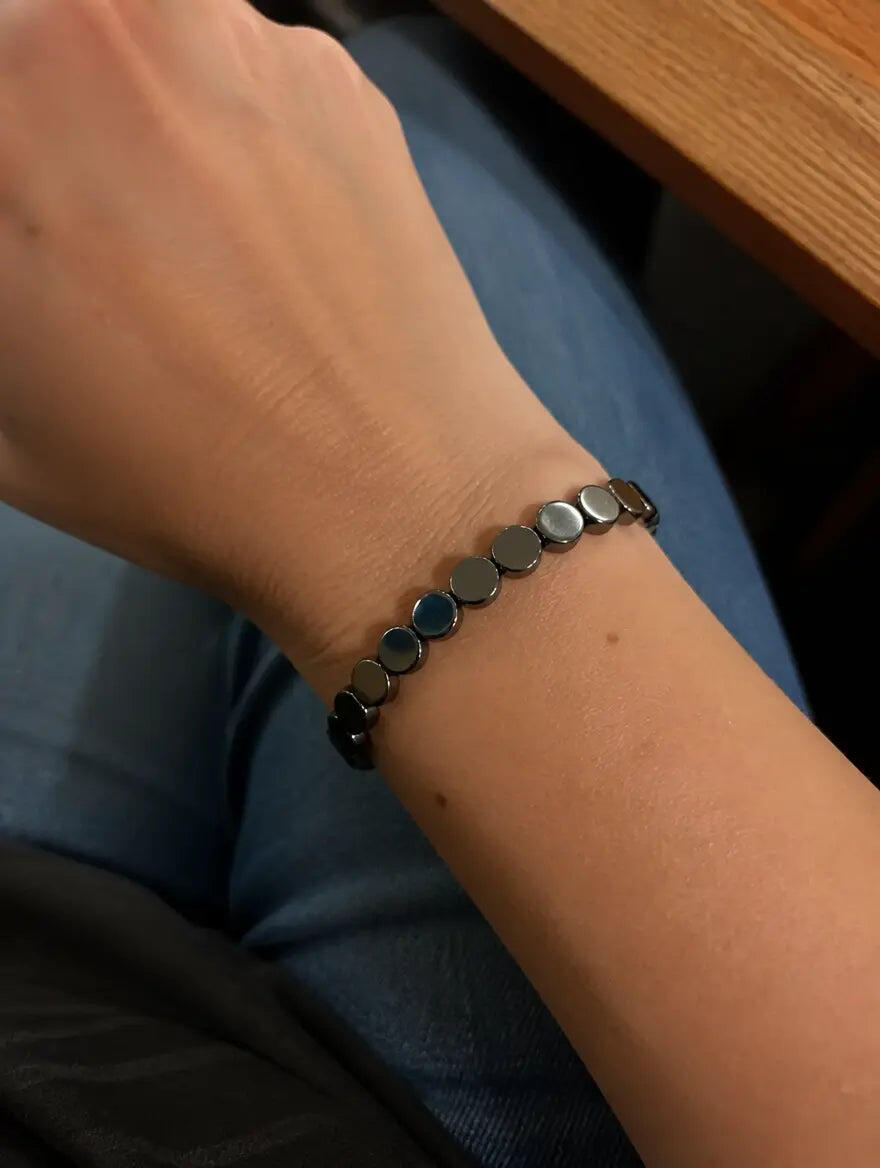
Love the cold touch. It stays with me through the day.

Stylish and refined. Design feels great and looks chic.

Real relief. It's my anchor every morning when I put it on.
Hematite is the iron-rich stone women have worn on their wrist for over 3,000 years. Haima is made of natural hematite, polished into flat beads and worn at your pulse point, right where your skin is thinnest. Heavy by design, cool to the touch, it becomes a daily grounding ritual you carry with you. Not a pill. Not a gadget. Just grounding on your wrist.
Why Women Choose Haima
A Daily Grounding Ritual
Natural Iron-Rich Hematite
Worn at Your Pulse Point
All-Day Stretch Fit, No Clasp
Couldn't load pickup availability
30-day money-back guarantee
BACK IN STOCK — Gold, Rose Gold & Silver
The first batch sold out in 11 days.
Restocks aren't guaranteed


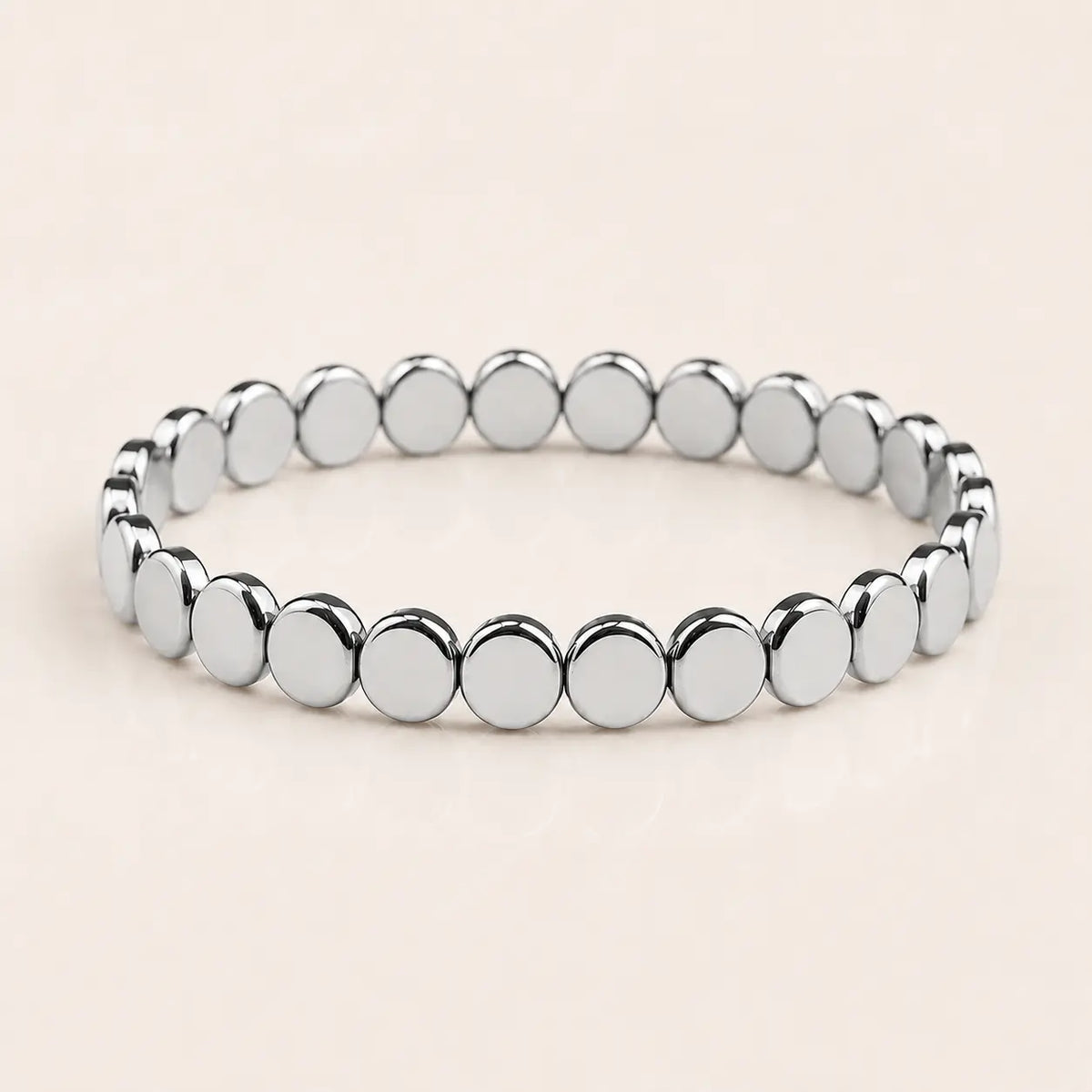
The Haima natural hematite bracelet is a women's bracelet made of 8mm polished natural hematite beads strung on a reinforced elastic cord. It's a piece of jewelry, worn as part of a daily ritual.

Raw hematite is a reddish-brown iron oxide. After being worked and polished to a smooth surface, it reveals its metallic steel-gray luster, like the beads on your bracelet. Its red color doesn't disappear; it simply reveals itself in a different form.
To see this for yourself, there's a simple test: the streak test. Rub a piece of hematite on an unglazed ceramic piece, and you'll see a reddish-brown mark appear. This characteristic mark allows you to identify hematite and reveals part of its true mineral nature. The Greek word haima, meaning "blood," actually refers to this red color.
Caution: this test is abrasive and can damage the stone's polish. If you wish to try it, use a piece of raw hematite rather than your bracelet to preserve its luster and finish.


For thousands of years, hematite has been part of women’s traditions and rituals.
In ancient Egypt, it was linked to protection, strength, and the symbolism of blood. Its dark metallic color and reddish tones made it a powerful stone in amulets, rituals, and moments of change.
Even its name comes from the Greek word haima, meaning “blood.” Ancient writers such as Theophrastus and Dioscorides also described hematite in some of the earliest texts about minerals and medicine.
Today, we understand much more about the body, hormones, and iron. Ancient women did not know the science behind these processes, but hematite continued to be passed down through generations as a symbol of strength, transformation, and feminine ritual.
A story that has lasted for thousands of years

One drop of jojoba oil at the pulse point, then the bracelet. A two-minute morning ritual.
Its weight, cool touch, polished finish and its place in a daily routine.
Raw hematite is red-brown. Polishing gives it a smooth, metallic gray surface. The red shows when you rub it on unglazed ceramic.
No. A bracelet is not a medical product and does not replace any treatment.
I've tried ashwagandha, magnesium, B12, and a $300 Oura ring. I've probably spent $500 on those things that did nothing. This bracelet was $45 and it was the first thing that actually felt different. I don't crash at 2pm like I used to. Could be coincidence. But I'm not taking it off to find out.
I'm not a crystal person. But hematite is literally iron oxide, the same element in your blood. That's what got me. The bracelet is much heavier than I expected, which I love. I touch the beads whenever the brain fog hits at work. Three months in, I haven't taken it off.
So glad I didn't wait. I ordered the Rose Gold on a Friday night. Went back to the site on Monday to check shipping and the Rose Gold was completely sold out. I hope they restock soon because my best friend wants one now.
I love that there's no app to check, no dose to remember and no routine to maintain. I just put it on in the morning and it's there all day. After years of complicated wellness protocols that I never stuck with, this is the first thing that actually stayed on. Literally. I haven't taken it off in two months.
Beautiful bracelet, genuinely well-made and heavier than I expected. I do feel calmer when I touch the stones throughout the day. Took 6 days to arrive instead of 4 (not a huge deal but just noting it). Product itself is excellent. I ordered a second one for my mom.
I'm you. PhD in biochemistry. I read papers for fun. I demand mechanisms and evidence. I almost didn't buy this. What got me over the line: iron oxide isn't magic — it's chemistry. The transdermal hypothesis is at least plausible. And I'd already spent over six hundred dollars on things that had stronger evidence and did absolutely nothing. So I spent thirty-nine dollars on something with a plausible mechanism and low risk. Six weeks later the outcomes are clear: better sleep, lighter cognitive load, more stable mood, improved morning energy. I still can't tell you with certainty that the mechanism is what they claim. I can tell you the outcomes are real. To the rational women still scrolling: your skepticism is valid and the outcomes are real. Both things are true.
I want to be precise about the order of events: I bought this bracelet reluctantly, as a last resort, after two years of foggy exhaustion and three doctors who told me nothing was wrong. I had low expectations. I gave it three weeks because the return policy made it risk-free and I was desperate. Something genuinely changed around week 3. My energy stabilized. The 2pm crash shortened. My husband noticed without being told. I've tried iron supplements — they made me nauseous and did nothing. I've tried every supplement category you can name. This was different. I don't fully understand why and I've made peace with that. The results are real. I'm still wearing it five months later and the improvement has held.
Better sleep. Less fog. More stable mood. More consistent energy. Six weeks. Four stars. No exaggeration. That's the review.
I thought this fog was what aging looked like. This bracelet showed me it wasn't. Four stars for changing that narrative.
I'd given up expecting anything. Stopped looking. And then this worked. Something shifted at week three and held through month four. Four stars for working when I'd stopped expecting it.
I said this to my husband when I bought it. Too good to be true. A bracelet for fatigue. Thirty-nine dollars. The mechanism sounds plausible but come on. I gave it three weeks because nothing else had worked and I was out of options. Week 3, something shifted. Fog lighter. Energy more stable. My husband noticed before I admitted it. I've been wrong about many wellness products. This is the one I'm glad I was wrong about. Still wearing it. Still better. Three months later.
I was on the fence for a month. What tipped me: the mechanism made sense, it was thirty-nine dollars, and the reviews were specific rather than hyped. Six weeks later: sleep better, fog lighter, mood more stable. Fence-sitters: it's worth the try. Four stars.
Cooperative. Trusting. On the same team. Since wearing this, my relationship with my body is good.
It said something would shift around three weeks. It did. It said give it three weeks. I did. It said results would be real. They were. Four stars for doing exactly what it said.
Month one: good. Month three: still good. Month six: still consistent. Four stars, measured over six months. That's the real test.
I almost gave up at day 14. Nothing felt different. Then around day 21 I realized I hadn't thought about being tired all day. That sounds small but it's enormous when fatigue has been your constant background noise for a year. Four stars — solid product that requires patience.
The product is genuinely good. Something real shifted at week three. Sleep more restorative, afternoon crash shorter, mood more stable. My husband noticed without being told. The shipping took 12 days with inconsistent tracking updates. One star off for that. Everything else earns the five.
Not a miracle. Not instant. Not for everyone, probably. But for me, in my situation, with my specific brand of exhaustion — it worked. Six weeks of consistent, measurable improvement. Four stars for what it actually is rather than what it's sometimes sold as.
Not parts. Not the functional subset. The whole person. Since wearing this, all of me is available. My whole person shows up.
I'm a nurse practitioner. Skeptical by training. Six weeks of wearing this: improved sleep architecture, less afternoon cognitive fog, more stable mood. I can't confirm the mechanism with certainty. I can describe the outcomes. The outcomes are positive. Four stars.
What used to be a best day is now the ordinary experience. Since wearing this, my best became my baseline.
My marriage. My family. My friendships. Since wearing this, I'm in the love. Present for it. Receiving it. Giving it.
Not just the immediate. The long haul. Since wearing this, I'm in it for the long haul — of being well, of being present.
At work. In relationships. In my own life. Full engagement. Since wearing this, full capacity for full engagement.
Especially if you're skeptical. The skeptics who try it and report back honestly — we're the ones you should trust.
Most reviews say week three. For me it was closer to week four. But it did arrive. Sleep noticeably more restorative. Afternoon manageable. Mood more even. Took longer for me than for others. Worked when it finally kicked in. Four stars.
Not the reason things are hard. The reason they go well. Since wearing this and having the capacity, I'm the reason things go well.
It renews. It restores. It's available the next day. That's what restorative sleep does. Since wearing this, the energy renews.
I'm the kind of person who needs to see the data before committing. Six weeks of data: consistent improvement across sleep, energy, and mood. Patient investment that paid off. Would recommend to other data-oriented skeptics. Four stars.
Not the edited, managed, compensated version. The full version — all my qualities present. Since wearing this.